

 Posts
PostsWhat Is The Vision For Open Government Entrepreneurship?
 Sep 21st, 2010
  23 Comments
 Mark Drapeau (Washington, DC) -
Tim O’Reilly often explains Open Government, or Government 2.0, as “Government as a Platform” on which citizens and build things for each other and participate in their government (rather than treating it like a vending machine). The co-founder of Personal Democracy Forum and techPresident Andrew Rasiej has a similar notion that he terms WeGovernment.
Right now, Open Government looks a lot like an app marketplace. There are innumerable meetups to discuss the topic matter, apps contests to prove the principle of community action, government challenges rebranded as something innovative, and a variety of small companies and individuals taking stabs at making the government’s vision of transparency and open data, improving collaboration, and increasing participation a reality.
But what if one were to ask, “Who are the highly influential / fastest growing / most profitable entrepreneurs leveraging Open Government?” Could you answer that question? And do lists like GovFresh’s recent “Ten Entrepreneurs Changing the Way Government Works” truly represent the full range of what’s possible with Open Government entrpreneurship topics, business models, and ambition? What about this list from Alan Silberberg, an “innovator, thought leader and a leading analyst on Government 2.0″?
What Is an Open Government Entrepreneur?
The classic example of terrific public use of open government data isn’t very sexy, but you nevertheless probably take advantage of it nearly every day. Does the word Accuweather mean anything to you? The data that Accuweather and similar organizations use very often comes from the Federal government’s National Weather Service, operated by NOAA. The private sector weather market is worth roughly $1.5 billion - and it’s built on open government data stores.
Accuweather isn’t an app, or a website, or a loosely-joined group of people working toward a common goal in their spare time. Accuweather is a business, founded by a graduate student in Pennsylvania decades ago. Not that there’s anything wrong with releasing an app, running a website, or fostering a community. But are those examples of entrepreneurship? And are apps contests and volunteer groups sustainable long-term citizen-driven solutions for peoples’ needs? Do you trust them?
Bootstrapped startups can lead to long-term profitable business success independent of the ecosystem of angel investors and venture capitalists. Will the Open Government community graduate from mainly working with Web 2.0 tools and iPhones to working on far-reaching sustainable software and other infrastructure that truly serves the majority of citizens, and may even start turning a profit by… actually selling goods and services? Will they build trust with customers and citizens over time?
Remembering ‘Apps For Democracy’
What does a vision of entrepreneurs unlocking government data for public good look like? Back in the “old days” of Open Government, I was asked to judge the first government apps contest, Apps For Democracy, which was founded by then-CTO of Washington, DC, Vivek Kundra (now of course, the national CIO). It was great for its time, demonstrating there was a community of developers who were interested in contributing to public service through their existing talents.
The judging gave me one of the most poignant moments in my personal Open Government thought evolution. We were looking at an app (I honestly forget which one… but it was similar to D.C. Walking Tours by Adam Boalt) that enabled users to input preferences like “walking during the morning” and “avoid Dupont Circle” and “likes museums and Chinese food,” and the app would make a map of a walking route with things on it that the user likes. What was interesting was what happened next - someone commented that it would be great to see that app in a kiosk next to the concierge desk in hotels around the city.
A hotel kiosk seems like it would be (1) fairly obvious how to use, because almost every adult has used a kiosk to get money or check into an airline flight or something similar, (2) innovative company marketing, because it’s a physical “billboard” in hotel lobbies, and (3) serving a large number of customers in a precise niche, DC tourists. Develop and continuously update the software through the cloud, get someone to make kiosks for you and ship them to customers, and license them to Starwood or Hilton hotels to improve their customer service in heavy tourist cities - sounds like a business model to me.
This exemplar, on the backdrop of that of Accuweather, allows us to ask: What’s truly changed about “Open Government entrepreneurs” in the two years since Apps For Democracy?
The Rise and the Fall Of the Goverati
 In early 2009, I coined the term “goverati” to describe,
…people with first-hand knowledge of how the government operates, who understand how to use social software to accomplish a variety of government missions, and who want to use that knowledge for the benefit of all.
The goverati include people in and out of government, and people with and without technical backgrounds. The goverati is open to all. And yet, it’s difficult to think of many people who, in the last two years or so, have become high-profile goverati thinking-and-doing leaders. I mentioned people in my Feb 09 article, and had others in my mind, who were part of the informal goverati tribe. Most of those people still are, and many are doing more than ever as thought leaders, event organizers, and tactical executors.
Why “the fall” of the goverati, then, you may ask. Because while there certainly is a core group leveraging social media, open source software, cloud computing, and mobile and geo-location technology and knowledge of government and the non-profit space to do well (and it may be that technically, this group has grown in size), the general enthusiasm, sense of adventure into the unknown, and novelty of trying things has largely disintegrated into a large conglomorate of events and blogs and apps with no general directon, and no emerging, clear standout businesses.
With so many societal problems ranging from local economic troubles, to the rising cost of education, to locating missing children, that could be potentially affected by unlocking public data and visualizing, analyzing, and utilizing it in new ways by leveraging other innovations, the question of why there aren’t more people joining the ranks of the goverati in order to help with these problems through entrepreneurship must be asked.
Two Great Examples of Open Government Entrepreneurship
Non-profit or for-profit, young or old, urban or rural… it just doesn’t seem like there are many entrepreneurs making a business model out of the cornucopia of Open Government. Why don’t Open Government entrepreneurs have business models akin to what a variety of people - UrbanDigs.com, among others - are doing with real estate and related data? The new UrbanDigs will charge $20 per month while empowering people to mine real estate data in real time. “Gov 2.0 success stories” in the blogosphere along these lines are rare.
There are exceptions, of course, but those seem to come from companies run BY “
PASSUR is an aviation business intelligence company, specializing in predictive data analytics for airlines, airports, and other aviation customers. They also contract with government agencies like the FAA and TSA. PASSUR’s customers utilize their live and historical information to make better decisions in real-time, increase sales, and improve servicing. At the Gov 2.0 Summit, the CEO and President of PASSUR James Barry stated,
I think that PASSUR, working with government data, in conjunction with the government, is a perfect example of the tenets of Government 2.0.
BrightScope, on the other hand, deals with data of a more financial nature; specifically, 401k data. At the Gov 2.0 Summit, BrightScope CEO Mike Alfred told an inspiring story of forming a business model around quantitatively rating 401k plans to give participants, plan sponsors, and advisors tools to make their plans better. All he needed was… the public data. From walking directly into the Department of Labor and asking for it, to filing FOIA requests and receiving piles of boxes, Mike Alfred and his co-founders - from San Diego - showed what can be done with a plan, some entrepreneurial spirit, and a little moxie.
Open Government Entrepreneurs Look Like ‘Regular’ Entrepreneurs
The most striking thing to me, as I sat in the Gov 2.0 Summit audience learning about PASSUR and BrightScope, was that the CEO’s speaking were really into business. Their business. Not being cool, not attending tweetups, not even technology. (Just look at Mike Alfred’s bio - Stanford graduate, financial literacy teacher, portfolio manager.) No fantasies about how open source code can save the world, no hopes for someday planning one’s own BarCamp, no accounts on 18 distinct social networks.
There’s no inherent problem with any of these things. Open source code is fine. BarCamps are useful. Some social networks are terrific. But has it occured to people that maybe the true Open Government entrepreneurs are… just like “regular” entrepreneurs?
What’s a “regular entrepreneur” though? Let me know what you think, but I’ll take a stab at this - people who have started companies before, who read Entrepreneur and Inc. and have a business plan, who perhaps even have an MBA or another advanced degree and some hardcore corporate experience. Maybe they’re not Millenials and “digital kids” swimming in THE FACEBOOK but rather Gen Xers with a decade of real-world training under their belts - not just in programming, but in finance, government, education, and other activities.
I have a feeling that’s the vision for Open Government entrepreneurship. I’m not yet sure what the implications of that might be.
Maybe you have a different viewpoint on the future of the goverati, the usefulness of Open Government data, or the definition of an entrepreneur. Regardless, perhaps there is no better way to summarize and end this post than with a simple quotation from Jim Traficant’s talk at the Gov 2.0 Summit: “The answer’s in the data - Let’s get to work.”
Mark Drapeau is the Editor of SECTOR: PUBLIC and the Director of U.S. Public Sector Social Engagement at Microsoft.
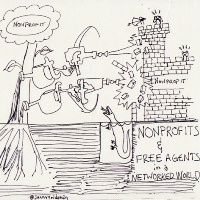
Pictures of a “lucid dreamer” and an “illuminati” from Flickr and used under a Creative Commons license.










Love the term “open government entrepreneurship.” Did you happen to tune into the TEDxChange webcast this past week? In Melinda Gates” chat she reinforced three items that the development community (and in my mind, both the gov”t and nonprofit at-large communities) could better leverage. These include: 1) real-time data, 2) entrepreneurship and 3) impeccable marketing. Your post puts together a good case about the merging of these concepts for good. Thanks for the strong insights.
Also-the World Bank just launched a new data.worldbank.org in an effort to release all of its data for free to the public. Hopefully, this is a trend other organizations in and outside of government will pick up on as well.
I would have attended the TEDxChange event in DC, but went to the Social Good Summit in NY instead. (There are too many good events.) Thanks for that summary of Melinda Gates” comments - I tend to agree, and suppose that what I wrote is along those same lines.
Mark I was in attendance for your talk to beyond 2010edmonton. Gret insight. I am reading gov loop and your website. these are great resources. Under best practices, we developed a complete online application for planning applications with a e circulation to 43agencies that review all applications singularly and respond using the net. We do not use any paper inprocessing these applications and have cut processing time. If you are interested, I can send the link to the story on word press.
BTW, can guest on windows weekly on twit.tv?
Open Government TV and our internet video platform is indeed a goveratti based enterprise formed by a regular entreprenur Keith Moore, whose mission it was to engage large businesses (like Micrososft), to help small businesses like 90% of the world’’s bussinesses including ours, to develop collaborations to create jobs, and restore our nation’’s economy. We invite those who embrace this mission to call 202-449-7705 and visit us at http://www.opengovtv.com. We desire to help our nation restore trust and integrity through the promotion and the implmentation of the Open Government Directive.
Thanks for the work you”re doing!
Nice post by Heather Leslie, “What is the vision for an open health platform?” here - http://omowizard.wordpress.com/2010/09/23/what-is-the-vision-for-open-health/
So is Carl Malamud an “open government entrepreneur” and where’’s the gray area? http://www.theatlantic.com/technology/archive/2010/09/now-this-is-how-a-checking-account-should-look/63544/
excellent points and the details are more specific than somewhere else, thanks.
- Thomas
Nice post Mark!
Thanks!
Is it alright to put a portion of this in my personal blog if I publish a reference point to this site?