

 Posts
PostsStill Waiting For Superman? Innovation Meets Education Outside The Classroom, Too
 Oct 21st, 2010
  2 Comments
Cameron Evans (Irving, TX) —
Waiting for Superman continues to get a lot of buzz. A documentary about failures in the American educational system told through the lives of a number of individual students, it has people questioning a host of inter-related issues. At the same time, controversial local education reformers like Washington, DC’s Michelle Rhee have been met with mixed reactions and may have short-lived terms due to the fall’s elections.
As the Chief Technology Officer of Microsoft Education, I find myself involved in such discussions on a daily basis, especially inasmuch as they involve technology and innovation. In that vein, Microsoft’s Bing recently joined the San Francisco Education Fund to host a screening of Waiting for Superman to a full house at the Kabuki Theatre in San Francisco. A grand evening of provocative and emotional conversations, to be sure. But what is the future of education reform? And are there alternative, creative means to improve education without formal and drastic alterations to American public schools? If so, what are the influences of technology on those means?
Opinions About Education Are Colored By Personal History
My family is a mix of Irish-Catholics, Sicilians, Italians, Native Americans, South Africans, and Americans of African origin. This kaleidoscope is the pair of rose-colored glasses that I wear into every situation – and most certainly into Waiting for Superman.
Growing up, my mother taught in public schools, and my father worked in a factory, with both of them members of their respective labor unions. We were a typical nuclear family of the age. During my childhood, I attended a variety of public schools – some great, some average, some dreadful – and the best magnet high school ever. For two years of junior high school, my older brother and I attended a private academy where we both had tremendous growth academically and artistically.
For the nearly 20 years since, I have been in the public service – as an armed service member, as a public schools executive, and now representing Microsoft Education technology to audiences around the country. I have crossed the world’s oceans to observe and learn about life from both developed and emerging neighbors. All of this affects how I approach the topic of education innovation.
Unfortunately, Schools Are Not Franchises
 Waiting for Superman opens with a provocative observation from the director and narrator, Davis Guggenheim. As he reflects on his morning ritual of taking his kids to school, he observes the three public schools that he drives past to drop his children off at a private school. He does this because he wants them to have a great education and a head start in life. But isn’t this strange, driving past one school, then another, on the way to yet another school?
Schools aren’t franchises. They are not equal, even though they might seem the name in name, or in the way their buildings look, or from the kinds of sports teams they have or buses they use. This made me think about what other kinds of institutions we exhibit this behavior with. In other words, what other entities would I drive past one, then another, then another, to finally arrive at once specific one that I thought was “best” for me or my family?
The one other entity I can think of besides schools is churches (houses of worship). Like schools, churches sound a lot the same in name, look a lot the same in architecture, and even have weekend mass at pretty much the same times. But there are reasons we will drive a little further to attend the 9:30 mass at St. Agnes’ rather than the 9:00 at St. Luke’s.
We would never drive past three Citibank ATM’s on the way to a fourth, nor pass up two Burger King’s on the highway to wait for that perfect third one. It’s wasteful and makes no sense. But unfortunately with schools, families that have options for their children’s education do this every day.
This observation permeates the documentary and it haunts you once you catch it.
Innovation Versus Outrage In Education Reform
Time magazine posed the question, “Can a movie change education?” The short answer is no – not alone. To paraphrase Bill Gates speaking in the movie, it will require a lot of “innovation and outrage” to change the current educational system.
Outrage is an interesting word choice, because it is not obvious who exactly should be outraged, and what the positive outcomes of that might be. Should the students trapped in failing schools be outraged? Perhaps they should. But from a child’s perspective, when you don’t know what you should know, how could you know that you are not getting it?
Should the parents of these children be outraged? Yes. But how many of them will see this movie? Unfortunate as this may be, I suspect that the socio-economic demographic of Waiting for Superman viewers is the same as that of people who have the option to drive past a failing school to send their child to a better one.
In my opinion, Gates is suggesting that this very demographic – the movie’s viewers, the people who drive by “bad” schools to drop of their children at “good” ones – should be outraged. For the time being, this demographic makes up the community with the voices, influence, and resources to bring about change in U.S. public schools. More importantly in my opinion, it is in everyone’s best interests to do so.
Break the System, Not the Teachers
So what can we do on the road to a solution? We will get to that, but first I will comment on what we might not do. Broadly speaking, the mainstream media suggested that Waiting for Superman portrayed teachers’ unions as the villain of the U.S. educational system. While that is a convenient view of the film, the true villain that the movie portrayed is anything that prevents great kids from having great teachers in great schools at scale across the country. Sadly, this villain has become the whole of the educational system itself, and not merely a single entity or stakeholder.
Guggenheim pointed out that each generation has attempted to make education better through legislation, policy, leadership, and practice. Over time, all of this uncoordinated good work has made for a system that does not consistently work for every child. This circles back to Gates’ call for not just outrage, but innovation – the need for creative and effective change in public schools on a national scale.
Innovation Outside the Classroom

So, what is a parent without school options to do? Wait for an innovative “Superman” to someday change the public school system?
Fortunately, maybe not. A strong meme among creative people in the technology community focuses on not just innovation in the classroom, or in schools, but also innovation in how learning takes place outside of the traditional classroom environment. The recent Gov 2.0 Summit in Washington, DC hosted a number of talks on this theme from education innovators. For example, Jim Shelton, the Director of the Office of Innovation and Improvement at the Department of Education (and formerly of the Bill and Melinda Gates Foundation), gave a wide-ranging talk about everything from social networks that link student peers with each other across school boundaries, to how cheap hardware devices and cloud computing are lowering the costs associated with delivering knowledge, to creative uses of data mining and adaptive algorithms to deliver deeply personalized experiences to young people. There is no reason that any of these things should be confined to a traditional classroom.
Dale Dougherty, of Maker Faire fame, took this even further in a talk about do-it-yourself (DIY) education. From the Gov 2.0 Summit program description of his talk, “A Smart Grid For Education”:
Let’s face it: schools are the coal-fired plants of our education grid. They provide “base load” education, but there are additional opportunities for learning everywhere. How can we make it easy to find those opportunities? How can we give students credit for them? Dale Dougherty, publisher of Make: Magazine and the wildly popular Maker Faire events, which draw hundreds of thousands of people to a festival of Do-It-Yourself science and technology innovation, will talk about his vision for turbocharging science, technology, and math education.
Surely, everyone reading this article knows that important aspects of education take place outside the classroom, and that learning continues long after formal schooling ends. But we rarely point it out so bluntly and creatively s Dougherty did. Education innovation is about what happens both inside and outside the classroom. How can we not only try to improve schools but also leverage technology and innovation to improve learning?
Our Choices Matter
My daughter goes to a public school. In fact, she attends a neighborhood school in walking distance from our home. It’s a great school where over 95% of the kids are proficient in reading and math for their respective grade-level on state assessments. However, I had a choice in where we bought our home.
It was touching for me to see the film, despite how much I already knew about U.S. education. Visit the film’s website to find showings in your area, and then visit Bing to learn how you can get involved with improving education in America.
Cameron Evans is the Chief Technology Officer for Microsoft Education. Read more of his thoughts on Waiting for Superman at his personal blog, HIGHER INNOVATION (http://www.higherinnovation.com/).
Photo of “superman” from Linus Bohman and used under Creative Commons. Photo of McDonalds from Ian Mutto and used under Creative Commons. Smart meter photo by Tom Raftery and used under Creative Commons.






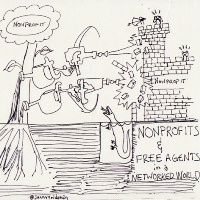









Imagine if we could connect the thousands of volunteers, board members, leaders and donors who are part of non-school tutoring/mentoring programs, arts & technology centers, etc. in on-line forums where they were engaged in discussions of how to provide systems of support, including public schools, that assured that more kids born in poverty were starting 21st century jobs/careers by mid twenties. Read some of the articles at http://tutor/mentor.blogspot.com and see how the Tutor/Mentor Connection, a small Chicago non profit, has been trying to build such a network for more than 18 years.
Look at the maps, graphics, and library of ideas, that can be used to expand the range of thinking of anyone in this discussion. Imagine how this might expand with the involvement of volunteers and leaders from the technology world.