

 Posts
PostsWhy The President’s Daily Brief Should Begin With A Map
 Dec 2nd, 2010
  5 Comments
Christopher Tucker (Washington, DC) —
Over the past couple years, we have been watching the slow yet inevitable collision of the Open Government Initiative and the White House’s so-called Place Based Policy Initiative. While Government 2.0 has progressed quite far since William Eggers coined the term “Government 2.0″ in 2004, many of its most interesting examples have been in its leveraging of “Where 2.0” inspiration. Open government that organizes its information and operations around location seems only commonsense when reflecting upon the old adage that “all politics is local”. And, in the national security community, information sharing and the achievement of geospatially-enabled situational awareness have become key drivers shaping reform and efficiency initiatives.
A recently published book by O’Reilly Press, entitled Open Government: Collaboration, Transparency, and Participation in Practice describes a set of principles and practices that empower the end users within and outside of government to be more than mere recipients of public sector information. These principles and practices enable all users to become creators and collaborators in the process of open government, even within the portions of government that are inherently secure, such as the Intelligence Community’s use of Intellipedia. Open Government/Government 2.0 uses the web as a platform to harness the collective intelligence of those in government and society, where the open system allows individualization and enhancement of capability by a dynamic community of end-users. But despite the excitement, hype, and genuine progress, it is the marriage of the Government 2.0 and the Where 2.0 communities that is necessary to realize both Good Government and a truly effective national security community.
Here I look at how the (generally secretive) U.S. Intelligence Community could better serve our nation by committing to the principles of Government 2.0 and Where 2.0 at the highest level possible – at the point where national security information about the most pressing issues of the day are conveyed to the President and other key policy makers. While it is an argument about how we should organize our underlying data and analyses more transparently within the Community, it is also an argument about the need for our government’s leaders to demand that such data be at their fingertips through technologies that offer transparency and accountability in part through geospatial-enablement. They should understand that if they cannot get access to such data in a place-based manner, then it is unlikely that the hard working national security and homeland security operators and analysts can.
Government 2.0 and Where 2.0 Meet the Intelligence Community
 With the appointment of the new Director of National Intelligence (DNI) James R. Clapper, there is a unique opportunity to apply a new approach to conveying national security information to the Commander in Chief. DNI Clapper is often described as the father of Geospatial Intelligence (GEOINT); In an earlier job, he himself coined the term and renamed and reorganized an intelligence agency around the concept.
Around that time, it became common to hear persons working in this field use phrases like “All actionable intelligence exists in space and time.” This has since become accepted wisdom by all national security professionals, and “the map” was henceforth accepted as the common frame of reference for all national security knowledge.
One undercovered topic in media coverage of DNI Clapper’s proposed reorganization of the ODNI bureaucracy are his efforts to re-tool the anachronistic President’s Daily Brief (PDB) to make it more responsive to the President’s needs. Currently, the PDB is a thin paper collection of highly vetted and heavily edited intelligence reports. This medium - changed very little from the age of typewriters and mimeographs - constrains the way in which the President receives, analyzes, and acts on the nation’s intelligence.
History and Evolution of the President’s Daily Brief
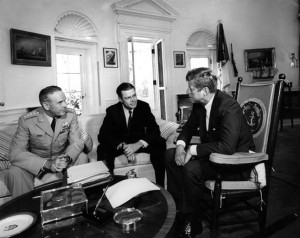 The PDB was established by the Central Intelligence Agency (CIA) during President Kennedy’s first year in office as an efficient means of conveying foreign intelligence regarding sensitive international situations. While the topics of 1960 were no less important than those of 2010, previous Presidents and National Security Advisers tend to agree on three key things: (1) the information environment of yesteryear was infinitely less complex, (2) the pace of change was much slower, and (3) that the number of international and non-state actors that had to be understood was orders of magnitude smaller.
While this format may have been sufficient 50 years ago, I believe that this model will fail us in the dynamic and evolving future. We are currently at an inflection point in how intelligence could and should be conveyed. The combination of the innovative James Clapper sitting behind the DNI’s desk, the momentum for “change” in government at all levels (AKA the Government 2.0 and Where 2.0 movements), and the availability of powerful new mapping technologies means that the outmoded and inadequate PDB framework could be set aside in favor of something novel: an interactive digital mapping interface, integrated into all of the national security community’s datastores.
I call this concept the President’s Daily Map.
The “President’s Daily Map” Promotes Sharing, Transparency, and Accountability
 There is more to the President’s Daily Map than merely informing the President and his key advisors about critical national security information every morning at 8am EST, as important as that may be. This 21st-century concept also has important ramifications for how information is shared 24/7/365 across the global U.S. national security community, and achieving a means for internal transparency and accountability.
How that works is deceptively simple. If information is shareable to the President’s Daily Map according to a known set of technical standards, then it is shareable to anyone else across the national security enterprise that has sufficient security credentials. This technologically-enabled relationship between analysts and decisionmakers provides a substantial means to demonstrate more transparent information sharing, anchored to real-world locations and times.
Such a system has a number of advantages: (1) Very complex modern national security issues would become more tractable to analysis; (2) Resource allocation issues (and shortfalls) would become more obvious; (3) National security managers would be better able to take evidence-based actions.
There is the risk of “information overload” associated with such a system of sharing and presenting data. Counterweighting this is the lack of illusion that 12 or so typed pages in a PDB constitute a meaningful means of informing the President of the United States; they almost certainly have ceased to. Moreover, this brings to mind New York University professor Clay Shirky’s classic line about the problem not being information overload, but rather “filter failure.” What if the PDM is not viewed at presenting too much information, but rather as an elegant filter for the vast amount of information that truly exists?
Complex Information For Complex Times
 Questioning the process by which information destined for the President is analyzed and compiled is nothing new. In fact, it goes back over 40 years to a recently declassified memo that Andrew W. Marshall wrote about his extensive study of the PDB process for Henry Kissinger. Even then there were many complicated issues regarding everything from the process of deciding what would be in the PDB to how feedback from the President, National Security Council, Defense Department, and others flowed back to CIA analysts, if at all. Yet, little has changed since then with regard to the final intelligence product presented to the Commander in Chief.
These days, matters are much more complicated than Kissinger (probably) could have imagined in 1970. Walter Pincus wrote a Washington Post article in 2009 about the different ways in which Presidents George W. Bush and Barack Obama utilize(d) the PDB, and the co-evolution of intelligence analysts to their most important audience member. A study by Kenneth Lieberthal, a senior fellow at Brookings and a National Security Council staff member in the Clinton Administration, described a process under President Bush that sometimes had analysts selectively choosing topics and using hyperbolic language to make items “sexy enough” to be included in the PDB.
It may be the case that making vast stores of data more discoverable, sharable, and ultimately, utilizable, is the solution to the informational and human quandries the President faces. (See a related video on this topic called Toward Living Intelligence here.) We often hear the phrase “connecting the dots,” but rarely do we hear about those dots being analyzed properly in space and time on within a GEOINT environment. And in the cases where they are, is that communicated to senior decisionmakers including the President on a real-time, interactive map?
In this author’s opinion, it would be extremely helpful for nationsal security professionals to open their eyes to alternative metaphors for conveying increasingly complex information to not only better inform our most senior leaders, but also make the Intelligence Community and the larger national security enterprise more effective. It is time for the secretive world of national security to ride the coat tails of the open, transparent Government 2.0 movement, take advantage of new means of information sharing and communication, and move beyond the limitations of a 1960’s-style PDB with the launch of a new President’s Daily Map.
Christopher Tucker is a member of the Board of Directors of the United States Geospatial Intelligence Foundation. An earlier version of this article originally appeared at the Huffington Post, where he has a regular column.
Photo of James Clapper from Wikipedia. Photo of President John F. Kennedy from the JFK Library. Photos of a 1689 world map, Where’s Waldo on a map and It’s Not That Simple used under Creative Commons.














Lol, i knew this was piddle when I read the title. You”re not actually talking about the PDB. You”re talking about the larger national security community.
The PDB is a few very well informed people talking directly to the president. Yes there is some reading being done but that’’s not the point. Its” not like the president walks in and says umm…i hear their is this country called afghanistan.
He already knows pretty much everything at this point so the daily brief is just an update on the critical issues. And, trust me on this when you are briefing someone on deep, complex issues you don”t need a map. You need a good personal relationship with the person telling you the story so you can develop out the nuance and the gravity of the situation.
What the PDB does need is much much different, but contact me outside of a comment and I”ll tell you that.
Oh, and by the way it has changed over the years, a lot.
Steve, this is partly about the PDB and partly about the community as a whole. Perhaps not every briefing should involve a map, but I think you”re being overly dismissive of the power of looking at data in different ways.
The larger point of this article, which I think you miss, is that with data/information/analysis getting more and more complicated (and with more [1] ”number crunching” and [2] nuance necessary to understand it), that new ways of looking at how the information is shared, discussed, and acted on could be valuable.
Certainly the author showed his bias by using the analogy of a map as the only visualization method for the PDB. However, it really doesn”t address the complexity of the problems that need to be presented. Maps are wonderful visualization tools (and have been for hundreds of years) and are often used in the PDB. But not everything is mappable. Many problems require very complex and abstract visualizations that would not make much sense if placed on a map. And some issues are just not mappable or even capable of being visualized beyond a simple text sentence. If Mr. Tucker had talked about some of the different metaphors for different types of problems, it would have strengthened his argument.
@Kelcy - I agree I think they missed the point of the PDB which is to give it that personal touch. A moment to go beyond tech, data, and bias and get to a deeper level of understanding in whatever way works. I really dont think the PDB suffers from a lack of innovation.
On the other hand, the larger Intel community suffers but not from the things Mark points out “number crunching” “nuance”. Those have been around since we sent up the first satellite and prob even before then. The community is decades deep in this struggle and faces challenges that are cutting edge problems.
Mark if you”re interested I would love to write a follow-up piece for you that either debates some of these PDB talking points or adresses the challenges of the IC in a world where millions of data points is the 90s and billions/trillions are where we are at.